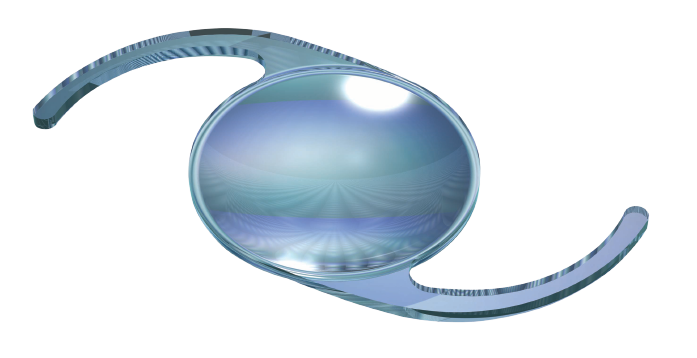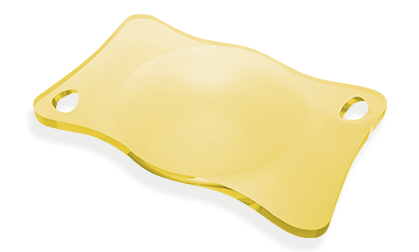
Halo & Glare? Not a Problem Anymore1,2,3
Minimized dysphotopsia due to reduced scattered light

Maximum Light Transmission into Retina (93%†)4,5 Unique sinusoidal pattern reduces light loss significantly, which brings a higher MTF result and better contrast sensitivity.

Comfortable Reading Distances6,7,8,9
SVT® provides spectacle-free life from all distances.

Optical Excellence10
Outstanding visual outcomes even in mesopic conditions.
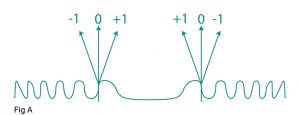
The sinusoidal diffraction pattern has naturally three different foci appear as –1st (works for far), 0th (works for intermediate), and +1st (works for near) diffraction orders (Fig A)11. That is why sinusoidal diffraction does not need to have an overlapping pattern and has a lower ring number.
– 1 ring for 3 different foci – Less glare and halo, more efficiency1,2,3
Enhanced light utilization12
Enhanced Sinusoidal Vision Technology that mimics a sine wave-like surface profile is designed to obtain the ideal optical performance: minimum dysphotopsia, maximum light transmission, optimum light distribution to let your patients enjoy seamless, continuous vision from all distances day and night.

AcrivaUD Trinova Pro C Pupil Adaptive® smartly distributes the light energy between the three foci according to different illuminance levels and pupil sizes to maximize light utility, retinal photoreceptor interactions, high contrast sensitivity, resolution and wide range of vision including reading distance and provides spectacle independence in every lighting situation.
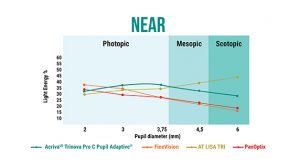
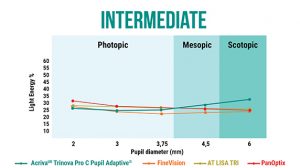

AcrivaUD Trinova Pro C Pupil Adaptive® distributes the light energy between the foci in such a way so that in mesopic illuminance levels, the light energy is directed to the near and intermediate vision, while in scotopic illuminance levels, this amount of light energy is distributed to far and intermediate vision more than near, as shown in the above figures in mesopic and scotopic conditions, and near vision is empowered for photopic conditions.
AcrivaUD Trinova Pro C Pupil Adaptive® distributes effective and efficient light energy into the near and intermediate foci while maintaining distance visual acuity due to minimized light loss in the diffraction orders provided by enhanced light distribution with patented Sinusoidal Vision Technology.
Pupil diameter changes by lightning condition and eye accommodation state.13,14,15
Changing pupil diameter affects our visual performance due to the retinal illumination level and the directional sensitivity of the retinal photoreceptor cells.16
Retinal image quality has been shown to correlate better with VA tasks of lower contrast and lower luminance than the task of photopic high contrast (HC)-VA. Therefore evaluating IOL performance and patient satisfaction in a standard examination room under the ideal conditions of 2-3 mm pupil diameter, mega contrast letters, and optimum light conditions do not reflect the real-life experience.17,18,19,20
NowAcrivaUD Trinova Pro C Pupil Adaptive®,with enhanced light distribution with patented Sinusoidal Vision Technology, each sinusoidal wave is optimized to reach an ideal design just like the Golden Ratio in nature. Thanks to renewed unique design, the lens adapts to the pupil diameter and provides maximum light efficiency, optimum energy distribution, and maximum visual acuity.



AcrivaUD Trinova Pro C Pupil Adaptive® is designed for today’s lifestyles; from viewing traffic signs comfortably and clearly while driving at night safely, to using mobile devices and computer screens to reading a book comfortably even in dim light with high-quality distance vision in a range of different light conditions. Thus it maximized spectacle independence at all distances and in every possible lighting condition.
AcrivaUD Trinova Pro C Pupil Adaptive® aims to improve patients’ quality of life by maximizing the quality of vision.
References